River cane
Arundinaria gigantea Grass family
Alabama has a native bamboo. Canebrakes once lined rivers across the state, and almost all of them are gone. We grow it for the stalks, which have more uses than any other plant on this list.
Draft. This guide was checked against Extension, USDA and poison-control sources in November 2026. It has not yet been reviewed by a botanist or, where it touches the law, an attorney, and it is hidden from search engines until it is.

Know it
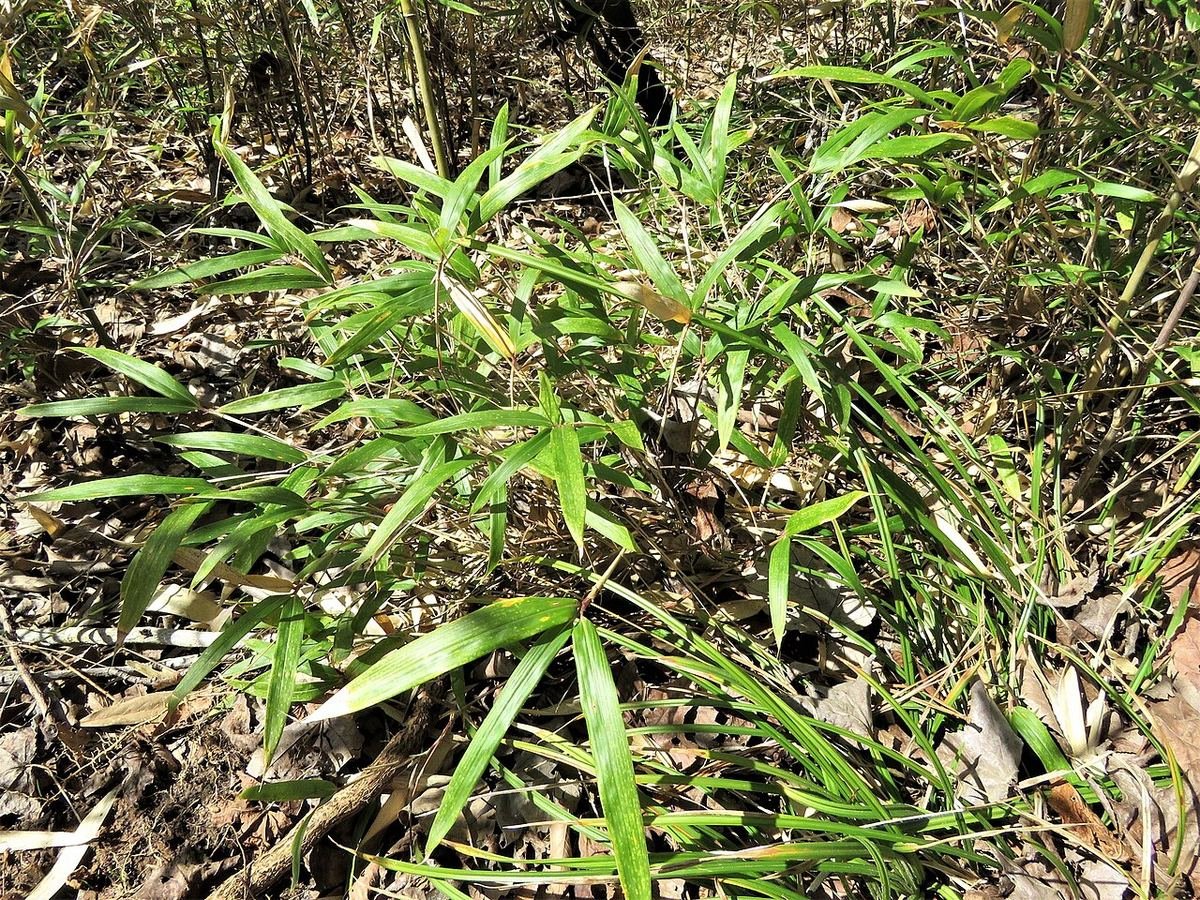
Straight, round, jointed stems from the thickness of a pencil to more than an inch, with a fan of branches at each upper joint and papery sheaths on new stems that later fall. Leaves are long, narrow and evergreen.
Not to be confused with golden bamboo
The bamboo taking over yards and creek banks around Birmingham is golden bamboo (Phyllostachys aurea), an Asian species and a serious invasive. Look at the branches. On river cane they rise almost straight up, close against the stem, in a tangled cluster, and the stem is rarely more than an inch thick. On golden bamboo the branches angle out at about 45 degrees and the stems are often two inches thick or more. Both can have a shallow groove above the branch, so do not rely on that. If in doubt, ask your county Extension office or a native plant society before you dig or plant. Never plant golden bamboo, and do not move its roots.
Where it grows
A canebrake is a single-species thicket on a river floodplain. Brakes once covered millions of acres of the Southeast, and it is commonly estimated that less than two percent remains, lost to farming, grazing and fire suppression.
Cane is one of the best plants there is for a stream bank. Its mat of underground stems holds soil through floods, and a strip of cane between a field or parking lot and a creek filters out sediment and fertiliser before they reach the water. It also spreads, so plant it where a mown edge or pavement will contain it.
Pollination
River cane flowers so rarely that most people never see it. The flowers are wind-pollinated, much of the seed is empty, and the stems that flowered often die afterwards.
Propagation
- Division is the reliable method. In late winter, dig a clump of two or three stems with at least a foot of the underground runner, better two, and the soil around it. Cut the tops back by half, replant at once, and water weekly for the first year. Bare stems without runner will not root in the garden.
- Seed, when a stand flowers, should be sown at once. Little of it is viable and it does not store.
A new planting does little for two years while it roots, then begins to run.
What you can and cannot eat
Edible
- Young shoots, cut in spring when a few inches tall and boiled, are edible and were eaten traditionally. Stands are so scarce that we do not harvest them.
Do not eat
- Seed. Cane seed was once ground for flour, but stands flower so rarely that we do not gather it. As with any wild grass seed, never eat grain carrying hard, dark, swollen bodies in place of seeds. That is ergot, a poisonous fungus.
Be certain of the plant before you eat any part of it. One web page is not enough. If you are in doubt, leave it.
Using the harvest
The stalks are the harvest. Cut canes that are at least two years old, in winter, with loppers, close to the ground. Our own rule is to take no more than one stem in five from a stand. Watch for snakes when cutting in a brake.
- Baskets and mats. Split, peeled and dyed cane is the material of the baskets of the Choctaw, Cherokee, Chitimacha, Muscogee (Creek) and other Southeastern peoples, including the double-woven baskets of the Cherokee, Choctaw and Chitimacha. It is an art that is still practised and that depends on access to healthy canebrakes.
- Garden use. Cane makes long-lasting bean poles, tomato stakes, trellises and fence panels.
- Tools. Fishing poles, flutes, blowguns and arrow shafts were all made from it.
Dry cut canes flat, in the shade, for several weeks before use.
Law and permission
Remaining canebrakes are often on public land or protected stream banks, where cutting or digging plants is prohibited. Several tribal nations are actively restoring cane for their basket makers. If you find a good stand, the right response is to ask who is looking after it. Start your own from a nursery division.
Check it against
- Alabama Plant Atlas, for where the species is recorded in the state
- USDA PLANTS Database, for native status and range
- Alabama Cooperative Extension System, for growing advice written for Alabama soils