Eastern prickly pear
Opuntia humifusa Cactus family
Alabama has a native cactus, and both its pads and its fruit are food. It grows on the hottest, driest, poorest ground on a site. The tiny hair-like spines are the only real difficulty.
Draft. This guide was checked against Extension, USDA and poison-control sources in November 2026. It has not yet been reviewed by a botanist or, where it touches the law, an attorney, and it is hidden from search engines until it is.

Know it
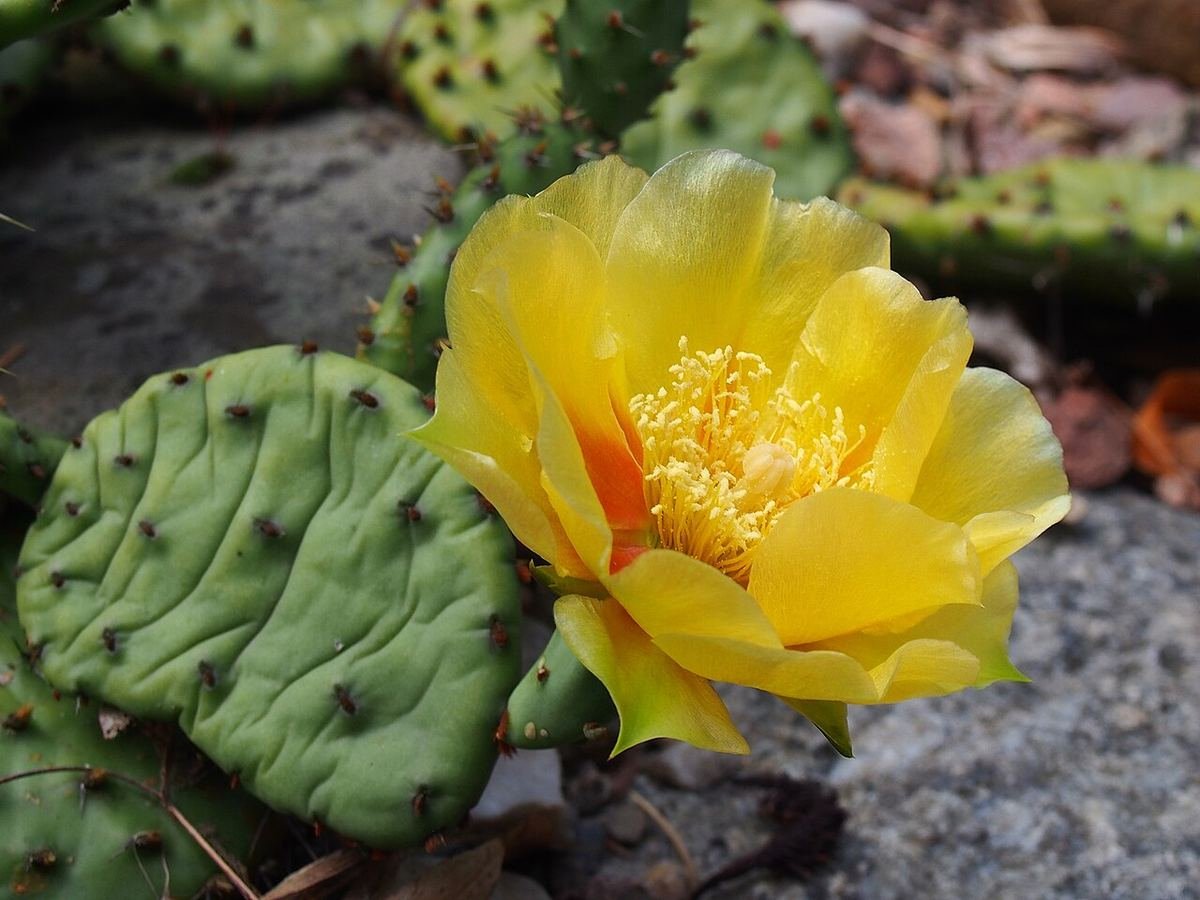
Flat, fleshy, oval green pads joined end to end, lying close to the ground. The pads are dotted with small tufts. Some carry a long spine or two. All of them carry clusters of tiny, barbed, hair-like bristles called glochids. Large, waxy, yellow flowers, often with a red centre, open in late spring. The fruit is club-shaped, an inch or two long, ripening to purplish red.
In winter the pads shrivel and lie flat. This is normal. They fill out again in spring.
Where it grows
Give prickly pear the place where everything else has died: a south-facing bank, a gravel strip, the top of a retaining wall. It needs no watering once rooted and no fertiliser at all. The only way to kill it is shade or wet soil.
In a public planting, keep it well back from paths and from anywhere children play.
Pollination
Bumblebees and many smaller native bees crowd the flowers, which close their stamens around a visiting bee. A single clump usually fruits.
Propagation
- Pads. Using tongs, twist off a healthy pad at the joint. Leave it in the shade for a week until the wound dries to a callus. Stand it upright with the bottom third buried in sandy soil. Do not water for two weeks, then water sparingly. It roots within a month or two.
- Seed works but takes years.
What you can and cannot eat
Edible
- Young pads, called nopales, picked in spring when they are bright green and thumb-thick.
- Ripe fruit, called tunas, when fully red-purple and slightly soft.
Do not eat
- Glochids. These are the hazard, far more than the big spines. They lodge in skin, lips and tongue and are nearly invisible. Never handle the plant bare-handed and never rub your eyes. A glochid in the eye needs a doctor. To clear them from skin, pull out the clumps with tweezers, then spread on a thin layer of white household glue, press gauze over it, let it dry for half an hour and peel it off. Tape works less well.
- Seeds in quantity. They are very hard. Strain them out or spit them. Eating large amounts of whole seeds has caused intestinal blockage.
Be certain of the plant before you eat any part of it. One web page is not enough. If you are in doubt, leave it.
Using the harvest
Handle everything with kitchen tongs. To remove glochids, hold each pad or fruit over a gas flame or grill and turn it until the tufts singe off, or scrub them hard under running water with a stiff brush. Then peel.
- Pads. Trim the edges, slice into strips, and grill or boil. The taste is like a tart green bean. Boiling draws out the slippery juice.
- Fruit. Halve the peeled fruit, simmer with a little water, mash and strain through cloth. The juice is a vivid magenta and makes jelly, syrup and drinks.
The sticky juice of the pads has a use of its own. In Mexico it has been mixed into lime plaster and whitewash for centuries to help them stick and shed water.
Law and permission
Wild prickly pear grows on glades and dunes that are among Alabama's rarest habitats, and many are protected. Do not collect pads from the wild. One pad from a neighbour's clump is all you need to start a colony.
Check it against
- Alabama Plant Atlas, for where the species is recorded in the state
- USDA PLANTS Database, for native status and range
- Alabama Cooperative Extension System, for growing advice written for Alabama soils