Muscadine
Vitis rotundifolia Grape family
The native grape of the South shrugs off the heat, humidity and diseases that kill other grapes. A single vine on a fence can give 50 pounds of fruit a year for decades.
Draft. This guide was checked against Extension, USDA and poison-control sources in November 2026. It has not yet been reviewed by a botanist or, where it touches the law, an attorney, and it is hidden from search engines until it is.

Know it
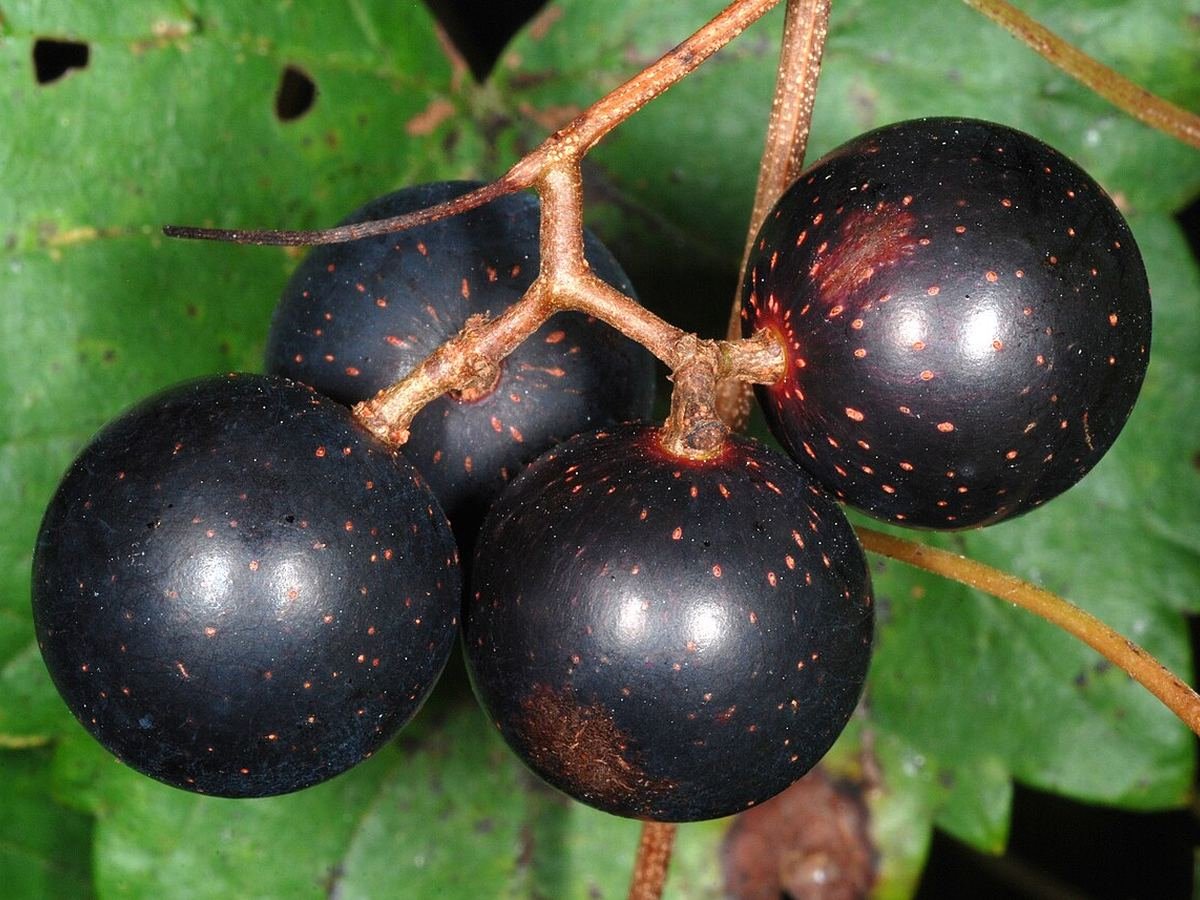
Round, glossy leaves two to five inches across with large, coarse teeth. The tendrils are single and unforked. The bark is tight and does not shred in strips like other grapes. The fruit is large, round and thick-skinned, bronze or purple-black, and grows in small loose clusters of a few berries. Each has up to five hard seeds.
Vines that are not muscadine
- Moonseed (Menispermum canadense) has grape-like black berries that are seriously poisonous and can kill. It has no tendrils, its leaves have no teeth, and each berry holds one flat seed shaped like a crescent moon.
- Virginia creeper has five leaflets and small blue-black berries that are poisonous. It also climbs by tendrils and often grows through muscadine, so check the leaf, not the vine.
- Peppervine is common in Alabama. It has finely divided leaves and shiny berries in pink, blue and black. Treat them as poisonous.
Toothed round leaf, tendrils, several seeds: muscadine.
Where it grows
In the wild it climbs to the top of the forest canopy. In a planting it needs a strong single wire five feet off the ground or a sturdy fence, full sun and good drainage. Plant vines 20 feet apart. Train one trunk up to the wire and one permanent arm along it in each direction.
Pollination
Wild vines are male or female, and only females fruit. Garden varieties are either female or self-fertile. A female variety needs a self-fertile one close by, in the same row or the next, no more than about 30 to 40 feet away. If you are planting a single vine, make sure it is self-fertile.
Propagation
- Layering is the easy way. In summer, bend a long new shoot to the ground, bury a section a few inches deep with the tip sticking out, and weigh it down with a brick. Cut it from the parent and move it the following winter.
- Softwood cuttings taken in June root under mist.
- Hardwood cuttings, the usual method for other grapes, root poorly.
- Seedlings do not come true, and half will be male.
What you can and cannot eat
Edible
- The fruit: pulp, juice and skin. Seeds can be swallowed or spat.
- Young leaves, for stuffing, like any grape leaf.
Do not eat
- The plant has no poisonous parts. The risk is picking a lookalike vine. See above.
Be certain of the plant before you eat any part of it. One web page is not enough. If you are in doubt, leave it.
Using the harvest
Muscadines ripen a few at a time and fall when ready. Pick every few days, or shake the vine over a sheet. To eat one, bite a hole in the skin and squeeze the pulp into your mouth.
For juice and jelly, simmer the fruit with a little water, mash and strain. Hull pie uses the cooked skins. The fruit also makes a distinctive sweet wine.
The vines
Prune hard every winter, by early March, cutting each side shoot back to a short spur about three inches long. The cut ends drip sap for days, which does no harm. Coil the long prunings into a ring while they are still flexible and they dry into wreath bases and basket frames.
Law and permission
Alabama has allowed home winemaking since 2013, with limits. You must be 21 with no felony conviction. A household may make up to 15 gallons in any three months and may not keep more than 15 gallons. None of it may be sold. It is not legal in dry counties or dry cities. Muscadines are among the fruits that may be picked at Little River Canyon National Preserve, up to a gallon per family per day.
Check it against
- Alabama Plant Atlas, for where the species is recorded in the state
- USDA PLANTS Database, for native status and range
- Alabama Cooperative Extension System, for growing advice written for Alabama soils