Hickory
Carya ovata, Carya tomentosa Walnut family
Shagbark and mockernut hickory are slow, patient trees that outlive the people who plant them. The nuts are sweeter than pecans and the wood flavours half the barbecue in the state.
Draft. This guide was checked against Extension, USDA and poison-control sources in November 2026. It has not yet been reviewed by a botanist or, where it touches the law, an attorney, and it is hidden from search engines until it is.

Know it
Hickories have compound leaves with a large end leaflet, and round nuts in a thick husk that splits into four sections.
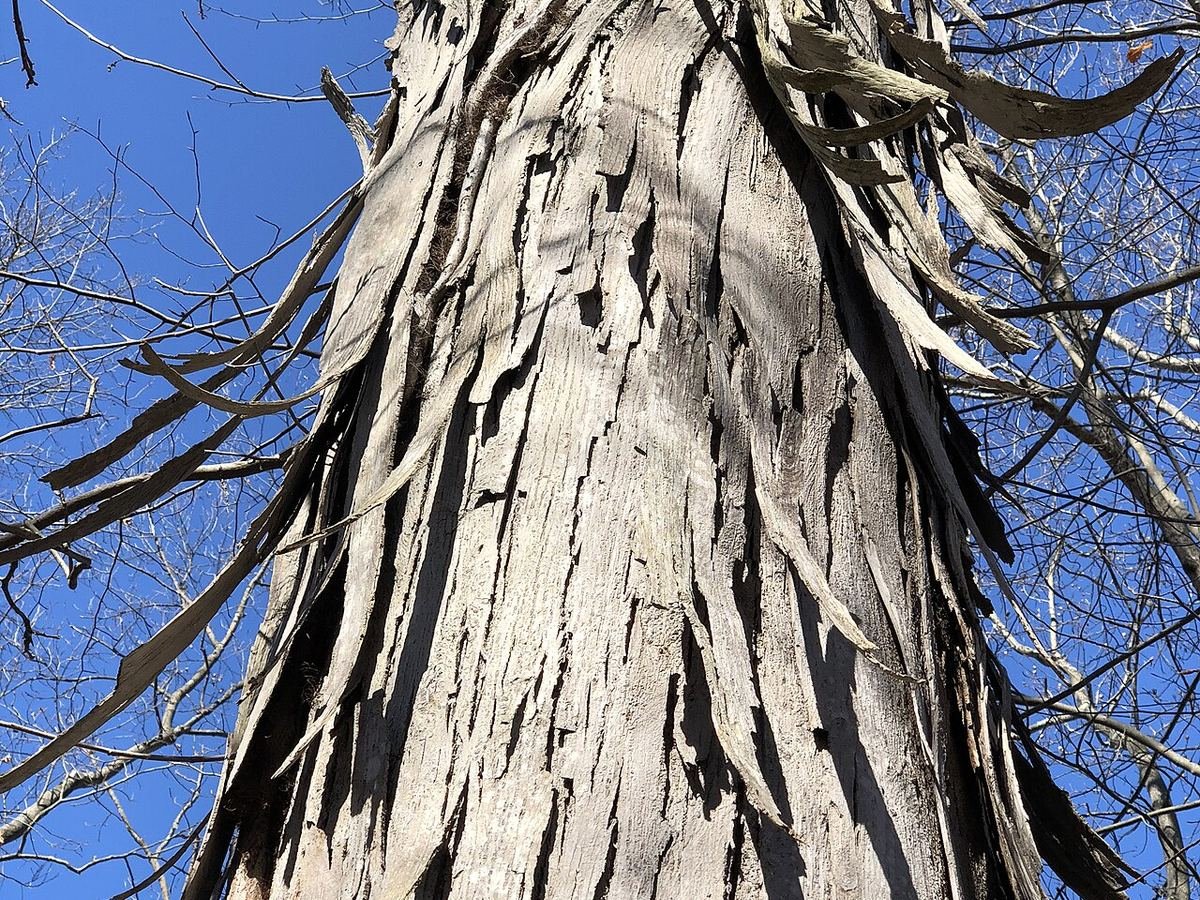
- Shagbark (Carya ovata) has usually five leaflets and grey bark that peels away in long vertical plates curling out at both ends.
- Mockernut (Carya tomentosa) has usually seven leaflets (five to nine) that are woolly underneath and smell strongly when crushed. Its bark is tight with a netted pattern. The nut has a very thick shell and a small kernel, which is where the name comes from.
Alabama has several other hickories. Bitternut is too bitter to eat. Pignut varies from sweet to bitter from tree to tree. Neither will hurt you.
Do not confuse it with buckeye
Buckeyes (Aesculus) are poisonous, and their nuts fall in the same season. A buckeye is a smooth, glossy brown seed with a pale "eye", in a leathery husk with no hard shell inside. Its leaflets fan out from one point like fingers on a hand. A hickory nut has a hard, ridged, pale shell inside the husk, and its leaflets sit in pairs along a stalk.
Where it grows
Hickories are upland forest trees. They grow slowly above ground for years while they build a taproot, then speed up. Plant them where a large, permanent tree is welcome, away from roofs and parked cars, because falling nuts dent metal.
Pollination
Long green catkins shed pollen on the wind in spring. A single tree can fruit, but the male and female flowers tend to open at different times, so two or more trees give a better crop. Heavy crops come every two or three years.
Propagation
- Seed. Collect nuts as they fall, husk them and discard floaters. Sow two inches deep in autumn under wire mesh, or chill in damp sand for 90 to 120 days and sow in spring.
- Grow seedlings in the ground or in very deep pots. A hickory that has circled a short pot rarely recovers.
- Be patient. Mockernut takes about 25 years to bear and shagbark about 40.
What you can and cannot eat
Edible
- Kernels of shagbark and mockernut, raw or toasted.
- Hickory milk. The Cherokee dish kanuchi is made by pounding whole nuts, shell and all, into a paste, simmering it in water and straining out the shell.
Do not eat
- Husks and shells.
- Rancid or mouldy nuts. Hickory nuts are oily and spoil. If a kernel is dark, shrivelled or smells of paint, throw it out.
- Anyone with a tree nut allergy should avoid them.
Be certain of the plant before you eat any part of it. One web page is not enough. If you are in doubt, leave it.
Using the harvest
Dry husked nuts for two weeks in a single layer, then crack them on their narrow edge with a hammer. Picking the meat out is slow work for a winter evening. Store kernels in the freezer.
Shagbark syrup is made from the bark, not the sap. Pick up plates of bark that have already fallen or are hanging loose, scrub them, toast them in the oven until fragrant, simmer them in water, strain, and boil the liquid with sugar. It is a flavoured sugar syrup with a smoky, nutty taste. Never pull tight bark from a living tree.
The wood and the cracked shells are the classic fuel for smoking pork. The wood is also what axe and hammer handles are made of.
Law and permission
Whether you may gather nuts depends entirely on whose land it is. Alabama State Parks do not allow it at all. Little River Canyon National Preserve allows up to a gallon of hickory nuts per family per day. The national forests in Alabama ask you to get a forest products permit first. See the full guide before you go.
Check it against
- Alabama Plant Atlas, for where the species is recorded in the state
- USDA PLANTS Database, for native status and range
- Alabama Cooperative Extension System, for growing advice written for Alabama soils