Sassafras
Sassafras albidum Laurel family
The tree with three kinds of leaf gives Louisiana gumbo its filé powder. The root that once flavoured root beer is a different story, and a federal one.
Draft. This guide was checked against Extension, USDA and poison-control sources in November 2026. It has not yet been reviewed by a botanist or, where it touches the law, an attorney, and it is hidden from search engines until it is.

Know it
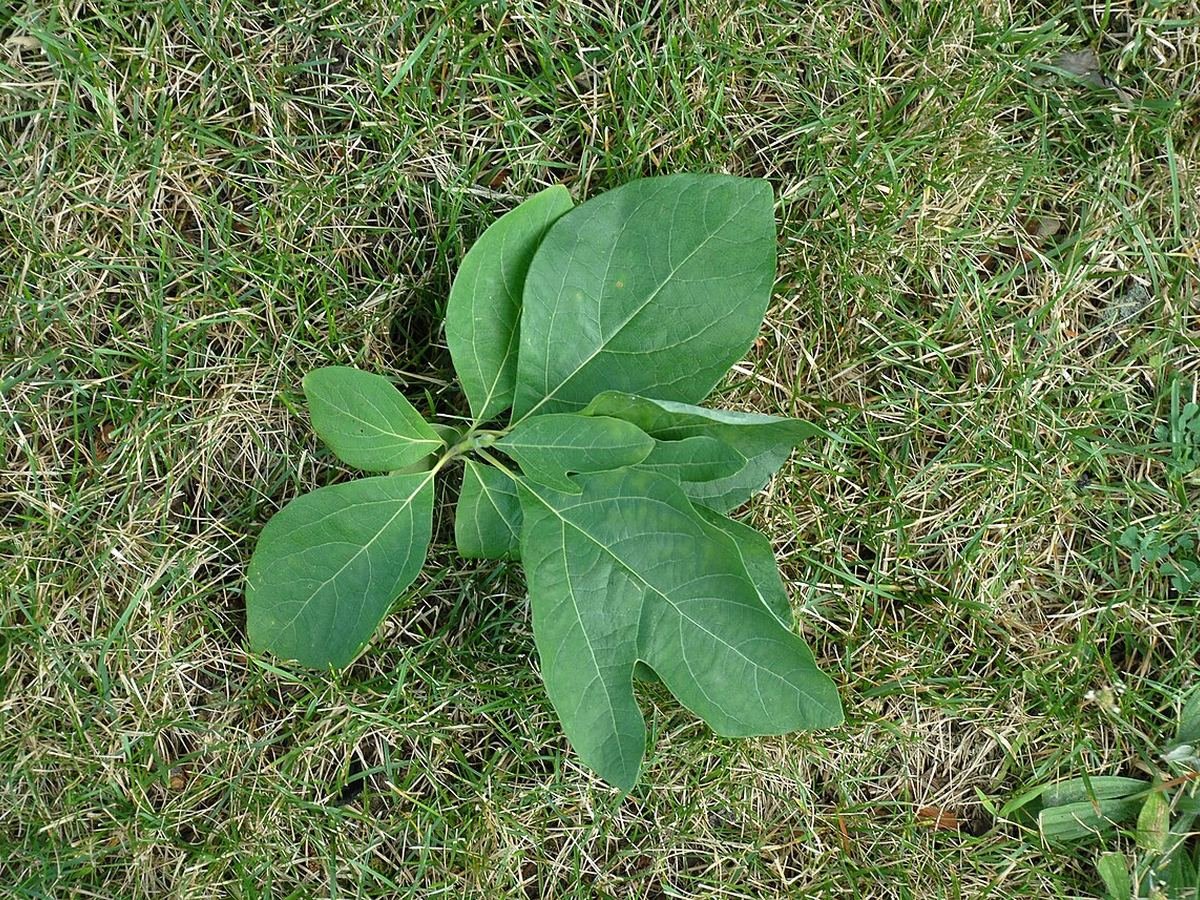
Sassafras carries three leaf shapes on one branch: a plain oval, a mitten with one thumb, and a three-fingered glove. Mulberry does this too, but mulberry leaves have toothed edges and milky sap. Sassafras leaves have smooth edges. Twigs are bright green. Every part smells of citrus and root beer when broken. Small yellow flowers open on bare twigs in March. Female trees bear dark blue fruit on bright red stalks in late summer, which birds strip within days.
Where it grows
Sassafras is a pioneer. It moves into cleared ground and forms a grove of stems joined underground. It is fast, tolerant of drought and bad soil, and turns orange, scarlet and purple in autumn.
Laurel wilt
A fungal disease carried by an introduced beetle is killing sassafras and its relative redbay. It has been confirmed in more than half of Alabama's counties, as far north as Madison County. There is no cure. Do not move firewood, and report trees that wilt and brown suddenly in summer to the Alabama Forestry Commission.
Pollination
Trees are male or female. Both flower, and only females fruit. Because a grove is usually one plant, a whole stand is often the same sex. For leaves this does not matter. For fruit to feed birds, plant several seedlings.
Propagation
- Seed. Collect the blue fruit as soon as it colours, clean off the pulp, and chill the seed in damp sand for 30 to 120 days. Sources differ on how long it needs.
- Root cuttings. Pencil-thick pieces of root, four inches long, laid flat in a pot in late winter will sprout.
- Suckers can be moved only when very small. Sassafras has a deep taproot and a tree over three feet tall rarely survives transplanting.
What you can and cannot eat
Edible
- Leaves. Dried and ground, they are filé, the thickener the Choctaw gave to Creole cooking.
Do not eat
- Roots, bark and sassafras oil. These contain safrole, which caused liver cancer in laboratory animals. The FDA banned safrole and oil of sassafras from food in 1960, and names sassafras tea as an example of a product it treats as adulterated. We do not recommend making root or bark tea, or chewing the twigs.
- Fruit. Leave it for the birds.
Be certain of the plant before you eat any part of it. One web page is not enough. If you are in doubt, leave it.
Using the harvest
To make filé, cut leafy branch tips in summer and hang them indoors, out of the sun, until the leaves are crisp. Strip the leaves, pull out the stems and thick veins, and grind the rest to a fine green powder in a blender or spice mill. Sift it and store it in a dark jar.
Stir filé into gumbo after the pot comes off the heat, or pass it at the table. If it boils it turns stringy.
The wood is light, aromatic and slow to rot. It was used for fence posts, furniture and dugout canoes.
Law and permission
Federal rule 21 CFR 189.180 prohibits safrole, oil of sassafras and food containing them from being sold. Only root-bark extract with the safrole removed may be used as a flavouring. The rule does not mention leaves, and filé is sold in every grocery store in the South, but we have not found an FDA statement on it. If you plan to sell filé, ask the Alabama Department of Public Health first.
Check it against
- Alabama Plant Atlas, for where the species is recorded in the state
- USDA PLANTS Database, for native status and range
- Alabama Cooperative Extension System, for growing advice written for Alabama soils