Winged and smooth sumac
Rhus copallinum, Rhus glabra Cashew family
The fuzzy red berry cones on Alabama roadsides make a tart pink drink and a lemony spice. Poison sumac is a different plant with white berries that lives in swamps.
Draft. This guide was checked against Extension, USDA and poison-control sources in November 2026. It has not yet been reviewed by a botanist or, where it touches the law, an attorney, and it is hidden from search engines until it is.

Know it
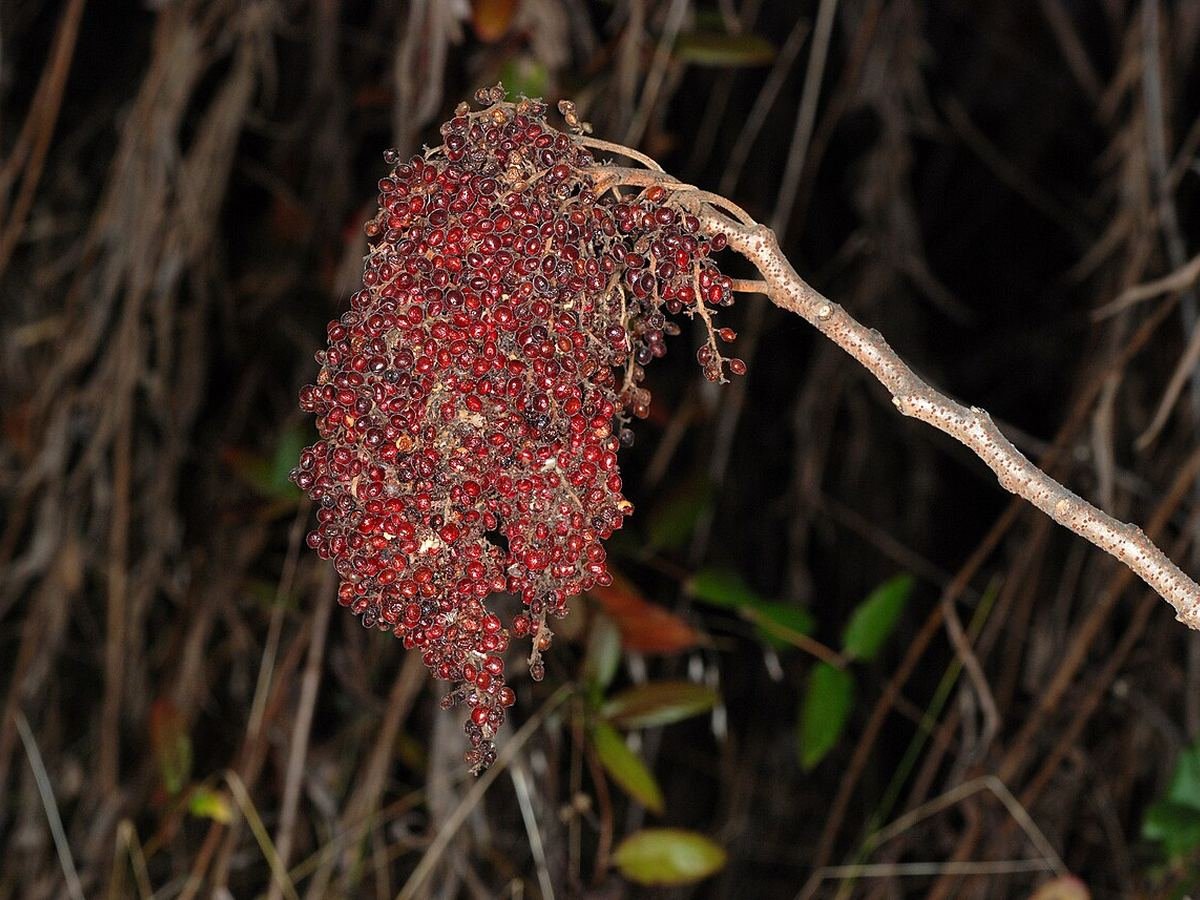
Sumacs have long leaves made of many pointed leaflets and turn brilliant red in autumn. The fruit is a dense, cone-shaped cluster of small, fuzzy, dark red berries at the branch tip. It stands upright at first, and on winged sumac it often nods over as it ripens.
- Winged sumac (Rhus copallinum) has glossy leaflets with smooth or nearly smooth edges and a narrow green wing running along the leaf stalk between them.
- Smooth sumac (Rhus glabra) has toothed leaflets, no wings, and smooth stems with a whitish bloom.
How to tell poison sumac apart
Poison sumac (Toxicodendron vernix) causes the same kind of rash as poison ivy, often severe. Never burn it. The smoke can injure the lungs.
- Its berries are white or greenish, smooth, and hang in loose strings from the side of the twig. Edible sumacs have red, fuzzy berries packed in a dense cluster at the branch tip.
- It grows in swamps, bogs and wet thickets. Edible sumacs are usually on dry banks, but do not rely on habitat alone.
- Its leaflets have smooth edges on red stalks, with no wing. Winged sumac leaflets are smooth-edged too, so the leaf alone will not settle it.
Red, fuzzy and packed tight at the branch tip is sumac. White or greenish, smooth and hanging in loose strings is poison sumac. A red winged sumac cluster that has nodded over is still sumac.
Where it grows
Sumac holds a dry bank together better than almost anything. It spreads by root suckers into a colony, so give it room or mow around it. Bees crowd the greenish flower spikes in midsummer, when little else is in bloom.
Pollination
Colonies are usually all male or all female, because each is a single plant. Only female colonies fruit. If you are planting for berries, take root cuttings from a colony you have seen in fruit.
Propagation
- Root cuttings. In late winter, cut pencil-thick roots into four-inch pieces and lay them flat an inch deep in a pot or bed.
- Suckers can be dug and moved in winter.
- Seed has a hard coat. Pour very hot water over it, soak for a day, then chill for 60 days before sowing.
What you can and cannot eat
Edible
- Ripe red berry clusters, steeped for a drink or dried and ground as a spice.
Do not eat
- Anything from poison sumac. See above.
- Sumac is in the cashew family. People who are allergic to cashews, pistachios or mangoes, or who react severely to poison ivy, may react to it. Try a small amount first.
Be certain of the plant before you eat any part of it. One web page is not enough. If you are in doubt, leave it.
Using the harvest
The sour taste is a coating of acid on the fuzz of the berries, and rain washes it off. Pick clusters in dry weather in late summer, when a berry touched to your tongue tastes sharply of lemon. Check inside each cone for insects.
- Sumac-ade. Break up six clusters into a pitcher of cold water, rub them between your hands, and leave for an hour or overnight. Strain through cloth to remove the fine hairs. Sweeten to taste. Do not use hot water, which pulls out bitter tannin.
- Spice. Dry the clusters, rub the berries off, pulse them briefly in a blender and sift out the seeds. The red powder is used like the sumac of Middle Eastern cooking.
Stems and leaves
The pithy centre of a sumac stem pushes out easily, leaving a tube. These were the taps used for collecting maple sap, and the stems of pipes. The leaves are rich in tannin and were used to tan leather and, with iron, to dye cloth black.
Law and permission
Most sumac grows on road banks. Highway verges are sprayed and mown without notice, so pick from land where you know the history and have the owner's consent.
Check it against
- Alabama Plant Atlas, for where the species is recorded in the state
- USDA PLANTS Database, for native status and range
- Alabama Cooperative Extension System, for growing advice written for Alabama soils