Yaupon holly
Ilex vomitoria Holly family
The only plant native to the United States that makes a useful amount of caffeine is a common Alabama hedge. Its roasted leaves make a tea that was carried hundreds of miles inland, as far as Illinois, about a thousand years ago. The berries are poisonous.
Draft. This guide was checked against Extension, USDA and poison-control sources in November 2026. It has not yet been reviewed by a botanist or, where it touches the law, an attorney, and it is hidden from search engines until it is.

Know it
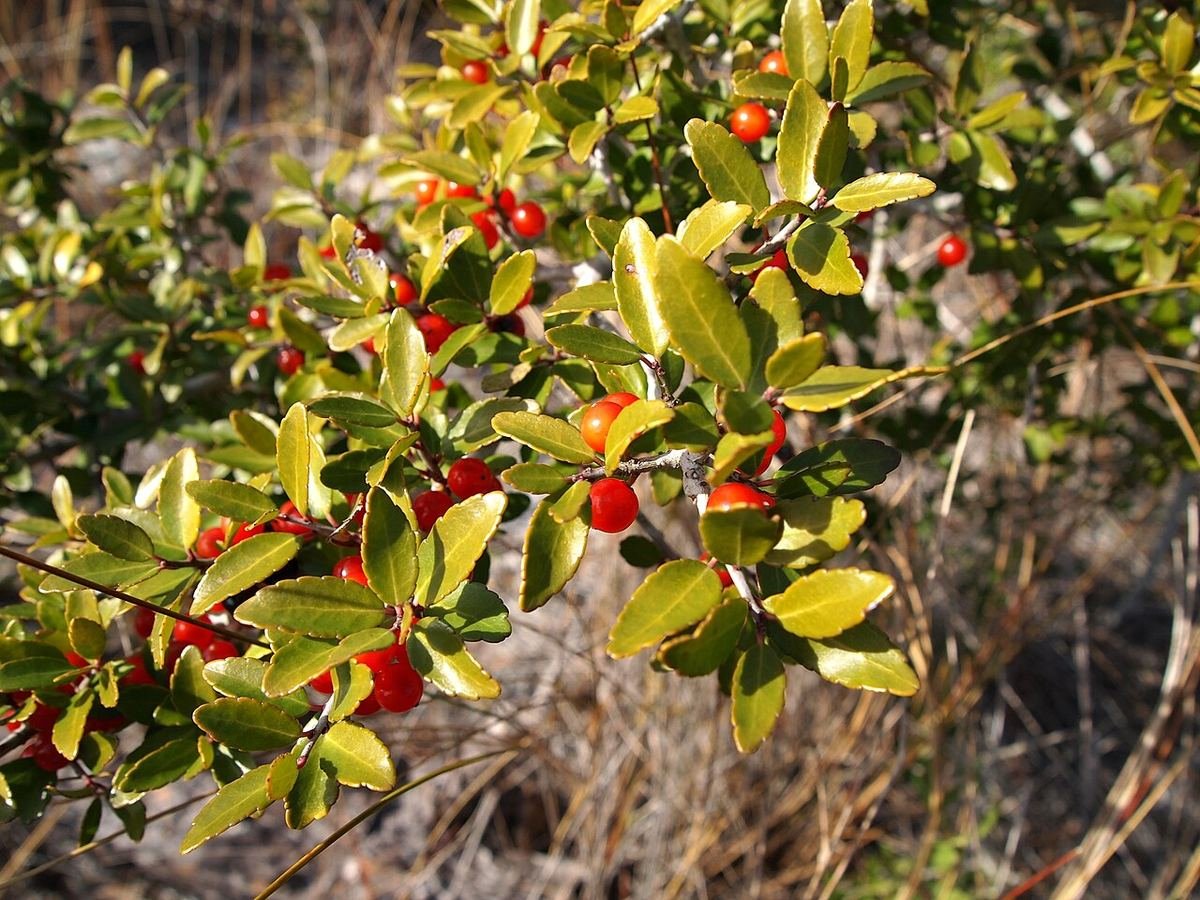
Small, stiff, evergreen leaves, half an inch to an inch and a half long, oval, dark and glossy, with a row of shallow rounded scallops along each edge. The leaves grow singly, alternating up the stem. Bark is smooth and pale grey. Female plants carry translucent red berries through the winter.
The lookalike that matters
Chinese privet, one of the most common weedy shrubs in Birmingham, has leaves of about the same size and is poisonous. Privet leaves have smooth edges and grow in opposite pairs. Yaupon leaves have scalloped edges and alternate. Check both features before picking. Boxwood, another common hedge, also has opposite leaves.
Japanese holly (Ilex crenata), a very common clipped hedge, passes both checks: its small leaves are scalloped and alternate. Its berries are black, not red, and they are poisonous. If you cannot confirm red berries on the plant, or a nursery label saying Ilex vomitoria, do not pick.
No other holly is a substitute. Use only yaupon.
Where it grows
Yaupon tolerates nearly anything, which is why landscapers use it as a clipped hedge around parking lots. The dwarf and weeping forms sold in garden centres are the same species and make the same tea.
Pollination
Plants are male or female. Bees visit the small white spring flowers heavily. Only females make berries, which matter to birds in late winter and do not matter for tea.
Propagation
- Semi-hardwood cuttings taken in late summer root well with hormone and humidity, and keep the sex of the parent.
- Suckers from the base can be dug in winter.
- Seed is slow and erratic. Leave it to the birds.
What you can and cannot eat
Edible
- Leaves and young green twigs, dried or roasted and brewed as tea.
Do not eat
- Berries. They cause vomiting and diarrhoea.
- Caffeine. A cup of yaupon has about as much as a cup of green tea, though it varies a good deal from plant to plant. The same cautions apply for children, pregnancy and heart conditions.
The Latin name is a historical mistake. Native peoples of the Southeast drank very large quantities of strong yaupon in ceremonies that included vomiting, and a European botanist blamed the plant. The leaves do not cause it.
Be certain of the plant before you eat any part of it. One web page is not enough. If you are in doubt, leave it.
Using the harvest
Cut branch tips at any time of year. Rinse them and strip the leaves.
- Green yaupon. Dry the leaves in a dehydrator or a 200°F oven until crisp. The tea is grassy, like green tea.
- Roasted yaupon. Spread dried leaves on a tray and roast at 350°F for 8 to 15 minutes, stirring, until brown. The tea is dark and toasty, with none of the bitterness of over-steeped black tea, because yaupon is low in tannin.
Crumble the leaves and steep a teaspoon per cup for five minutes.
Law and permission
Clipping a hedge that is not yours is still taking someone's plant. Ask the property manager, who is usually glad of the free pruning. Avoid hedges beside busy roads and any that have been sprayed. Dried tea leaves fit Alabama's cottage food law, which covers dried herbs. Confirm with the health department before you sell.
Check it against
- Alabama Plant Atlas, for where the species is recorded in the state
- USDA PLANTS Database, for native status and range
- Alabama Cooperative Extension System, for growing advice written for Alabama soils